
CBSE sample papers 2025-26 for class 10 Science (Section C) continues from this page. There are separate pages for Section A and Section B.
Section C
Q30. Reflection from Curved Surfaces
Arnav was making notes and he wrote down the following statements from his understanding of reflection from curved surfaces:
- Concave mirrors can produce both real and virtual images depending on the position of the object.
- Convex mirrors always produce real, inverted images regardless of the object’s position.
- In both concave and convex mirrors, the image location can be determined using the mirror formula: 1/f = 1/v + 1/u, where f is the focal length, v is the image distance, and u is the object distance.
Choose the correct option:
- A. I and II
- B. I, II and III
- C. II and III
- D. I and III
Correct Answer: D. I and III
Explanation:
- Statement I is correct: Concave mirrors can produce both real and inverted images (when the object is beyond the focus), and virtual and erect images (when the object is between the focus and the pole).
- Statement II is incorrect: Convex mirrors always produce virtual, erect, and diminished images, not real or inverted ones.
- Statement III is correct: The mirror formula 1/f = 1/v + 1/u is applicable for both concave and convex mirrors using proper sign conventions.
Q31. Choose the correct option from the below which explains the reason for us to perceive the day sky as blue:
- A. As sunlight passes through the atmosphere, shorter wavelengths, such as blue are scattered more than other colors.
- B. The sky appears blue because all colors are scattered equally, but blue light is stronger and more visible to the human eye.
- C. The blue color of the sky is due to longer wavelengths like red and orange scattering more than shorter wavelengths, making blue stand out more.
- D. The atmosphere contains blue-colored particles that give the sky its blue appearance.
Correct Answer: A
Explanation:
Sunlight consists of many colors with different wavelengths. When it enters Earth’s atmosphere, shorter wavelengths like blue are scattered more efficiently by the small particles and gases in the air. This phenomenon is known as Rayleigh scattering. Because blue light is scattered in all directions and reaches our eyes from every part of the sky, the sky appears blue to us.
The following question consists of two statements – Assertion (A) and Reason (R). Answer these questions by selecting the appropriate option given below:
- A. Both A and R are true, and R is the correct explanation of A.
- B. Both A and R are true, and R is not the correct explanation of A.
- C. A is true but R is false.
- D. A is false but R is true.
Q32. The following question consists of two statements – Assertion (A) and Reason (R). Answer these questions by selecting the appropriate option given below:
A. Both A and R are true, and R is the correct explanation of A.
B. Both A and R are true, and R is not the correct explanation of A.
C. A is true but R is false.
D. A is false but R is true.
Assertion (A): A point object is placed at a distance of 26 cm from a convex mirror of focal length 26 cm. The image will not form at infinity.
Reason (R): For above given system, the equation 1/f = 1/v + 1/u gives v = ∞.
Correct Answer: C. A is true but R is false.
Explanation:
In a convex mirror, the focal length is taken as positive, and the object distance is always negative. Using the mirror formula:
1/f = 1/v + 1/u
Let f = +26 cm and u = –26 cm
1/26 = 1/v – 1/26
⇒ 1/v = 1/26 + 1/26 = 2/26
⇒ v = 13 cm
This means the image forms at a distance of 13 cm behind the mirror, not at infinity. Hence, Assertion is true (image does not form at infinity), but Reason is false (v ≠ ∞).
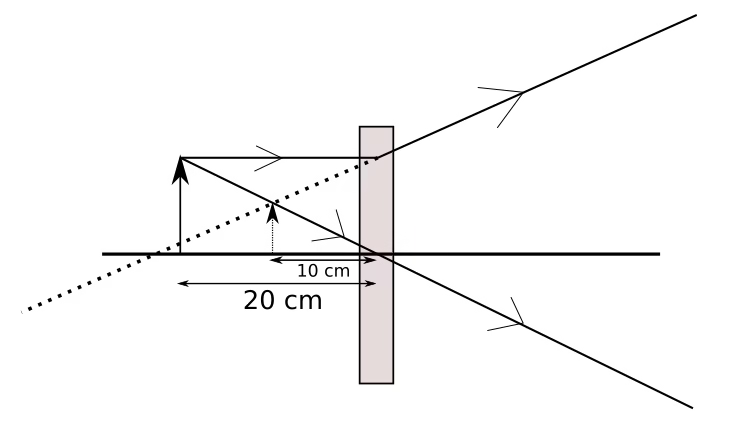
Q. 33
The above image shows the formation of an image with an optical instrument.
A. Identify the optical instrument (shown schematically as a rectangle) in the image.
Answer: The optical instrument is a concave mirror.
B. What type of image is formed in this case?
Answer: A real, inverted and diminished image is formed.
C. Based on the measurements given in the image, calculate the focal length of the instrument.
Answer:
Object distance (u) = –20 cm
Image distance (v) = +10 cm
Using the mirror formula:
1/f = 1/v + 1/u
1/f = 1/10 – 1/20 = (2 – 1)/20 = 1/20
∴ f = 20 cm
So, the focal length is 20 cm.
Q. 34
Attempt either option A or B.
A.
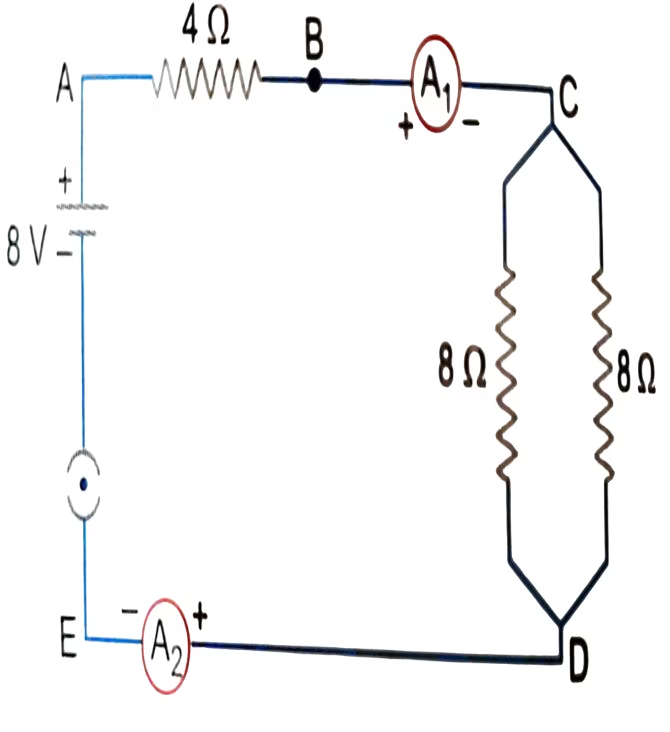
Find out the following in the electric circuit given in the figure:
(i) Effective resistance of two 8 ohm resistors in the combination.
The two 8-ohm resistors are connected in parallel.
Using the formula for parallel resistance:
1/R = 1/R₁ + 1/R₂ = 1/8 + 1/8 = 2/8 = 1/4
∴ R = 4 Ω
Effective resistance of the two 8-ohm resistors = 4 Ω
(ii) Current flowing through the 4-ohm resistor
The total circuit now has a 4-ohm resistor in series with the effective 4-ohm resistance from the parallel combination.
So, total resistance (Rtotal) = 4 + 4 = 8 Ω
Supply voltage (V) = 8 V
Using Ohm’s Law: I = V / R
I = 8 / 8 = 1 A
Current flowing through the 4-ohm resistor = 1 A