
CBSE sample paper 2025-26 for class 12 Economics is out now. Here we have provided solution for Economics sample paper in this page. The solutions are along with explanation for you to prepare for your board exams.
Section A – Macro Economics
Question 1
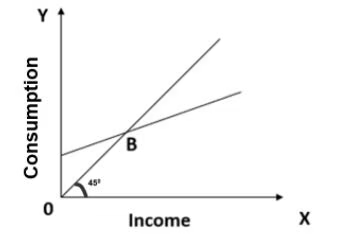
With reference to the given diagram, which of the following is true at point B?
- A. Slope of Consumption Curve = 0
- B. Average Propensity to Consume = 0
- C. Slope of Saving Curve = 1
- D. Average Propensity to Consume = 1
Answer: D. Average Propensity to Consume = 1
Explanation: Point B in the consumption curve typically refers to the break-even point, where Consumption = Income. At this point, the Average Propensity to Consume (APC = C/Y) is equal to 1.
Question 2
“Real Gross Domestic Product (GDP) is estimated to attain a level of ₹ 173.82 lakh crore in the year 2023-24. The corresponding Nominal GDP is estimated to stand at ₹ 295.36 lakh crore in the same year.”
On the basis of the given data, the value of GDP deflator would be _____.
- A. 295.36
- B. 58.85
- C. 169.92
- D. 173.82
Answer: C. 169.92
Explanation: GDP Deflator = (Nominal GDP / Real GDP) × 100 = (295.36 / 173.82) × 100 ≈ 169.92
Question 3
“Money is non-perishable and is acceptable to anyone at any point of time.”
Identify, the function of money indicated in the aforesaid statement and choose the correct option.
- A. Store of Value
- B. Medium of Exchange
- C. Unit of Account
- D. Standard of Deferred Payments
Answer: A. Store of Value
Explanation: The statement highlights how money can retain its value over time, indicating its function as a store of value.
Question 4
Read the following statements carefully:
Statement 1: Devaluation of currency is said to occur when the exchange rate is decreased under the Fixed Exchange Rate System.
Statement 2: Under the Floating Exchange Rate System, competent authorities do not maintain foreign exchange reserves.
In light of the given statements, choose the correct option from the following:
- A. Statement 1 is true and Statement 2 is false.
- B. Statement 1 is false and Statement 2 is true.
- C. Both Statements 1 and 2 are true.
- D. Both Statements 1 and 2 are false.
Answer: A. Statement 1 is true and Statement 2 is false.
Explanation: Devaluation happens only in a fixed exchange rate system. In a floating system, countries still maintain reserves to stabilize currency fluctuations.
Question 5
Refer to the given diagram carefully:
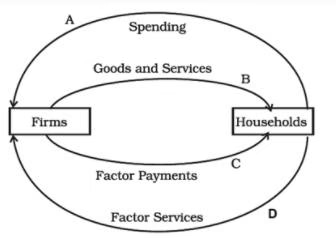
The arrows C and D represent ______ Market.
- A. Factor
- B. Goods
- C. Stock
- D. Financial
Answer: A. Factor
Explanation: In the circular flow of income, arrows representing factor services from households to firms and factor payments from firms to households constitute the factor market.
Question 6
Deflationary Gap refers to the gap by which ___________ falls short of the Aggregate Demand required to establish full employment equilibrium.
- A. ex-ante Aggregate Demand
- B. ex-post Aggregate Demand
- C. ex-ante Aggregate Supply
- D. ex-post Aggregate Supply
Answer: A. ex-ante Aggregate Demand
Explanation: A deflationary gap occurs when the planned (ex-ante) aggregate demand is less than what is required for full employment.
Question 7
Read the following statements carefully:
Statement 1: Final Goods do not undergo any further transformation at the hands of any producer.
Statement 2: Final goods may get transformed during their consumption by the ultimate purchaser.
In light of the given statements, choose the correct option from the following:
- A. Statement 1 is true and Statement 2 is false.
- B. Statement 1 is false and Statement 2 is true.
- C. Both Statements 1 and 2 are true.
- D. Both Statements 1 and 2 are false.
Answer: C
Explanation: Final goods are not meant for resale or further production, but they can still be transformed during consumption (e.g., food).
Question 8
On the basis of the given information, Money Supply (M1) would be ₹ _____ crore. (Choose the correct option)
| S.No. | Components | Amount (in ₹ crore) |
|---|---|---|
| (i) | Currency held by the Public | 320 |
| (ii) | Net Demand Deposits with Commercial Banks | 260 |
| (iii) | Net Time Deposits with Commercial Banks | 200 |
Options:
A. 580
B. 780
C. 675
D. 875
Answer:
Correct Option: A. 580
Explanation:
Money Supply (M1) = Currency held by the public + Net Demand Deposits with Commercial Banks
= ₹320 crore + ₹260 crore = ₹580 crore
Note: Net Time Deposits are part of M3, not M1.
Question 9
Read the following statements: Assertion (A) and Reason (R). Choose the correct option from those given below:
Assertion (A): (A): External Assistance is recorded in the Current Account of the Balance of Payments of a nation.
Reason (R): External Assistance includes bilateral and multilateral loans received/extended by a nation.
- A. Both A and R are true, and R is the correct explanation of A.
- B. Both A and R are true, but R is not the correct explanation of A.
- C. A is true, R is false.
- D. A is false, R is true.
Answer: D
Explanation: External assistance is recorded in the Capital Account, not the Current Account.
Question 10
Reserve Bank of India (RBI) was established in the year ____.
- A. 1934
- B. 1935
- C. 1936
- D. 1937
Answer: B. 1935
Question 11
For a hypothetical economy, assuming there are only two firms (A and B) with equal Gross Value Added (GVA).
On the basis of the following data, estimate the value of Domestic Sales of Firm A:
| (i) | Value of output of Firm B | ₹1,000 crore |
| (ii) | Purchases by Firm A from Firm B | ₹300 crore |
| (iii) | Exports by Firm A | ₹200 crore |
| (iv) | Purchases by Firm B from Firm A | ₹250 crore |
| (v) | Additions to stock of Firm A | ₹150 crore |
Answer: ₹250 crore
Explanation: Domestic sales = Sales to Firm B = ₹250 crore. Exports and stock additions are not part of domestic sales.
Question 12
“The statutory requirement of the Reserve Ratio (RR) acts as a limit to the amount of credit that banks can create.”
Justify the given statement with the valid explanation.
OR
The Reserve Bank of India uses various instruments to control credit creation in the economy.
Do you think that availability of credit is essential for economic growth? Support your answer with a valid reason.
Answer: Yes, the statutory requirement of the Reserve Ratio (RR) acts as a limit to the amount of credit that banks can create. When banks are required to keep a certain percentage of their deposits as reserves, it restricts the amount available for lending. This reduces the credit multiplier effect and limits the overall money creation in the economy. OR Yes, availability of credit is essential for economic growth. Credit enables households to consume and firms to invest, which raises the level of aggregate demand. Increased investment also leads to more employment, higher production, and income generation in the economy.
Question 13
Ms. Sarika is a retired government employee. Every month, she earns rental income from a property she owns. She has also invested in fixed deposit, which provide her with interest income. Occasionally, she receives cash transfers from her family members abroad.
Classify, Ms. Sarika’s income as factor income or transfer income, giving valid reasons in support of your answer.
OR
“Under the Expenditure Method, the value of Gross Domestic Product (GDP) can be estimated by adding the final expenditure incurred by all the sectors of an economy.”
In the light of the given statement, explain the expenditure incurred by any two sectors.
Answer:
The two types of income are:
Factor Income: Income from salary, interest on deposits, and rent is earned through providing factors of production (labour, capital, land).
Transfer Income: Remittances received from her brother in the USA are unilateral transfers that do not involve any productive activity in return.
OR
Real GDP: Calculated at constant prices, it eliminates inflation effects.
Nominal GDP: Calculated at current prices, includes inflation.
Better Indicator: Real GDP is a better measure of economic welfare as it reflects actual changes in production and purchasing power.
Question 14
“Mr. Spector, a normal resident of XYZ country, took a $1 million loan from an overseas bank to expand his manufacturing business. During the same year, the Government of XYZ country borrowed $5 billion from an international financial institution to cover the Balance of Payments (BoP) deficit prevailing in the country.”
Mishika, an economics student, read the above information and identified both the transactions cited, as autonomous transactions in the BoP account of XYZ country.
Do you agree with Mishka’s identification of the underlying concept? Give valid arguments in support of your answer.
Answer:
Yes, Mishika is right. Both private loans and borrowings from IMF are autonomous transactions because they are undertaken for developmental purposes and not to correct a disequilibrium in BoP. They are independent of BoP status.
Question 15
Refer to the given image carefully:
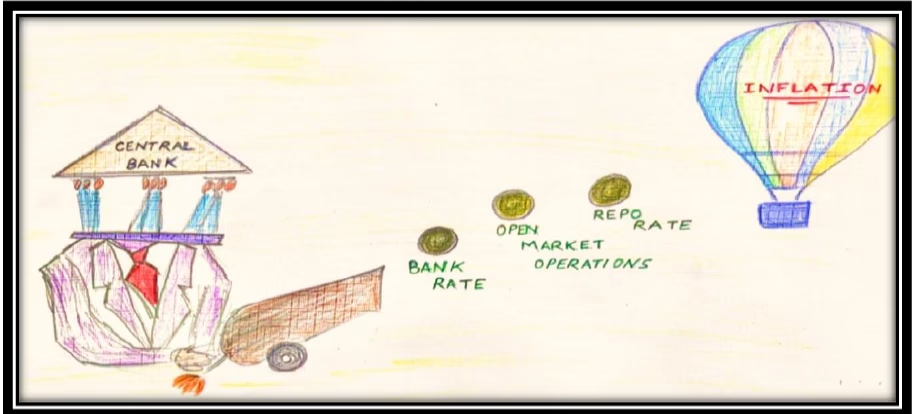
Explain any two indicated measures taken by the Central Bank to control the highlighted macroeconomic issue.
Answer:
Monetary Measures:
1. Increase in Repo Rate – discourages borrowing, reduces money supply.
2. Open Market Operations – selling government securities to reduce liquidity.
Fiscal Measures:
1. Increase in direct taxes – reduces disposable income and demand.
2. Curtailment of government expenditure – reduces pressure on supply and prices.
Question 16A
(I) Suppose in an economy, the Marginal Propensity to Consume (MPC) is 0.8. The government introduced an investment project of ₹1,000 crore which led to a manyfold increase in National Income (Y) and Consumption Expenditure (C).
Estimate:
(a) Value of Investment Multiplier (k)
(b) Missing Values of (i) and (ii)
| Rounds | Change in Investment (ΔI) | Change in Income (ΔY) | Change in Consumption (ΔC) | Change in Savings (ΔS) |
|---|---|---|---|---|
| I | 1,000 | 1,000 | 800 | 200 |
| II | 800 | 640 | 160 | |
| — | — | — | — | |
| — | — | — | — | |
| (i) | (ii) | 1,000 |
(II) “Sum of the Average Propensity to Consume (APC) and Average Propensity to Save (APS) is always equal to one.”
Justify the given statement with the help of a suitable argument.
Answer
(I) (a) Value of Investment Multiplier (k):
k = 1 / (1 – MPC) = 1 / (1 – 0.8) = 1 / 0.2 = 5
(b) Missing values:
Total Change in Investment (ΔI) = ₹1,000 crore (initial investment)
Total Change in Income (ΔY) = k × ΔI = 5 × ₹1,000 crore = ₹5,000 crore ⇒ (ii)
Since MPC = 0.8, Total Consumption = 0.8 × ₹5,000 crore = ₹4,000 crore
Therefore, (i) = Total Change in Investment (sum of all ΔI) = ₹1,000 + ₹800 + 640 + … till infinity = ₹5,000 crore
Final Values:
(i) = ₹5,000 crore
(ii) = ₹5,000 crore
(II) Justification:
By definition, APC = C / Y and APS = S / Y.
We know that Y = C + S (National Income = Consumption + Savings)
So, APC + APS = (C/Y) + (S/Y) = (C + S)/Y = Y/Y = 1
This shows that the sum of APC and APS is always equal to one, as the entire income is either consumed or saved.
OR
Question 16B
(I) Suppose in a hypothetical economy, people save 20% of their additional income. Ex-Ante Investments equals ₹ 100 and the equilibrium level of income stands at ₹ 700. Calculate dissavings at zero level of income.
(II) Define Effective Demand. Explain the adjustment mechanism to attain the level of Effective Demand, if ex-ante Aggregate Demand is more than ex-ante Aggregate Supply.
Answer
(I) Calculation of Dissavings at Zero Level of Income:
Given:
MPS (Marginal Propensity to Save) = 0.20
Investment (I) = ₹100
Equilibrium Income (Y) = ₹700
At equilibrium: Y = C + I
⇒ 700 = C + 100
⇒ Consumption (C) = ₹600
Now, consumption function is:
C = C₀ + MPC × Y
Where MPC = 1 – MPS = 0.80
600 = C₀ + 0.80 × 700
600 = C₀ + 560
⇒ C₀ = 600 – 560 = ₹40
So, at zero income (Y = 0), consumption = C₀ = ₹40
Dissaving at zero level of income = ₹40
Answer: Dissaving at zero income = ₹40
(II) Effective Demand:
Effective Demand refers to the level of aggregate demand which is fully met by the corresponding level of aggregate supply, and where the economy is in equilibrium.
Adjustment Mechanism:
If ex-ante Aggregate Demand (AD) is more than ex-ante Aggregate Supply (AS), then unplanned inventory depletion takes place. Producers respond to this shortage by increasing production. As a result, income and output rise. This process continues until AD equals AS — the point of effective demand — where the economy reaches equilibrium.
Question 17
Refer to the given text carefully:
Revenue receipts of the Union Government of India, consisting of tax revenue and non-tax revenue increased year-on-year by 14.5% in the financial year 2023-24, with robust growth in both tax and non-tax revenues.
In spite of the global trend of widening fiscal deficit and increasing debt burden, India has remained on the course of fiscal consolidation. In the post-covid period, significant fiscal consolidation could be achieved largely due to buoyant government revenues. The favourable fiscal performance in the financial year 2022-23, emerged as the cornerstone of India’s macroeconomic stability.
The fiscal deficit of the Union Government has been brought down from 6.4% of Gross Domestic Product (GDP) in the financial year 2022-23 to 5.6% of GDP in the financial year 2023-24, according to the data released by the Office of Controller General of Accounts (CGA).
Strong growth in direct and indirect taxes on account of resilient economic activities and increased compliance meant that the tax revenues generated exceeded the budgetary estimates.
Additionally, higher-than-budgeted non-tax revenue in the form of dividends from the Reserve Bank of India (RBI) has buffeted revenue receipts. In combination with restrained revenue expenditure, these buoyant revenues ensured lower deficits.
A decomposition of the fiscal deficit over the past few years reveals that with a narrowing revenue deficit, a larger share of the fiscal deficit is being accounted for by capital outlay. This suggests that the productivity of borrowed resources has improved.
Source: Economic Survey 2023-24
On the basis of the given text and common understanding, answer the following questions:
(I) Differentiate between the two types of revenue receipts as indicated in the above text.
(II) Elaborate the reasons behind reduction in fiscal deficit of India for the financial year 2023-24.
Answer
(I) Difference between the two types of revenue receipts:
- Tax Revenue: This includes compulsory payments made by individuals and businesses to the government. In the text, tax revenue comprises direct and indirect taxes, which increased due to resilient economic activity and better compliance.
- Non-Tax Revenue: These are receipts that the government earns apart from taxes, such as dividends from public sector enterprises or the Reserve Bank of India (RBI). The passage mentions higher-than-budgeted non-tax revenues, particularly dividends from the RBI.
(II) Reasons behind the reduction in fiscal deficit in 2023-24:
- Buoyant Tax Revenue: Strong growth in both direct and indirect taxes, due to economic resilience and better tax compliance, exceeded the budgetary targets.
- Higher Non-Tax Revenue: The government received more dividends than expected from institutions like the RBI.
- Restrained Revenue Expenditure: The government managed its spending efficiently, especially on recurring expenditures.
- Productive Capital Outlay: A larger portion of the fiscal deficit is now used for capital expenditure rather than revenue spending, improving the productivity of borrowed funds.